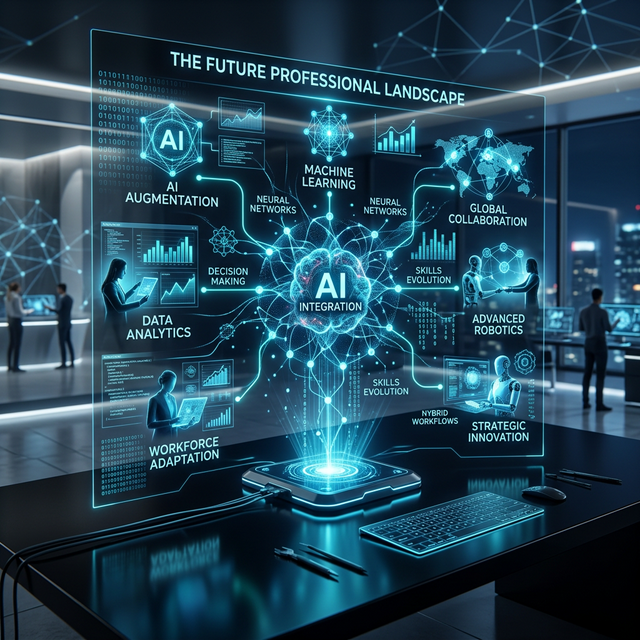
We are witnessing the end of the "knowledge worker" as fundamentally defined throughout the late 20th and early 21st centuries. Rote memorization, basic syntax programming, and mid-tier copywriting are no longer monetizable skills. The modern era strictly rewards the "Systems Architect"—the professional capable of orchestrating complex artificial intelligence APIs to execute vast, multi-node workflows simultaneously.
1. The Rise of the Micro-Enterprise
Historically, scaling a business required vast amounts of capital to hire a deep organizational chart to handle communications, code deployment, and media synthesis. Through deep API integrations, a solitary engineer can now structure automated logic arrays that execute these tasks silently in the background. The solo operator, bolstered by server-side AI processing, competes directly with traditional, sluggish enterprise infrastructures.
2. Asynchronous Logic Systems
The archaic reliance on synchronous communication (e.g. constant meetings) is highly inefficient network friction. Deep AI integration transitions teams into strict asynchronous methodologies. Instead of briefing an employee, you prompt a parameterized workflow container. The system evaluates the prompt, executes the code, and alerts human supervisors only during predefined anomaly conditions or error logs.
3. Copilots and Code Execution Synthesizers
Programming logic is rapidly evolving. The syntax itself is no longer the barrier; problem articulation is. Utilizing advanced editor integrations (like local IDE LLM agents), a developer spends less time chasing missing semicolons or parsing Stack Overflow threads. They spend their cognitive RAM exclusively on database schema strategy, security implementation, and high-level UX flows, trusting the integrated AI to rapidly autocomplete the boilerplate functions.
4. Continuous Learning vs. Hardcoded Skills
The pace of machine learning advancement means typical "hard skills" deprecate rapidly. In 2026, the only viable meta-skill is adaptability—the speed at which you can parse new technical documentation, structure it mentally, and synthesize a working deployment. Treating yourself as an adaptable machine learning node prevents occupational obsolescence.
5. Critical Implementation Upgrades
If your professional workflow currently relies entirely on organic output, apply these patches:
- Stop typing routine emails manually; utilize context-aware generative networks to output standard communication templates instantly.
- Connect your daily tasks to a macro-level tracking system. Force every API to log outcomes so you can review metrics algorithmically rather than emotionally.
- When faced with a complex logic bug, do not attempt to brute force it manually. Output your current state to an LLM to generate an alternate architectural perspective.
// SYSTEM SUMMARY
The future narrative belongs to those who view Artificial Intelligence not as a competing workforce, but as a suite of powerful computational APIs ready for integration. Shifting your mental paradigm from "doing the work" to "designing the system that does the work" is the only sustainable trajectory. The modern professional is an orchestrator of digital logic arrays, not a manual laborer of code.