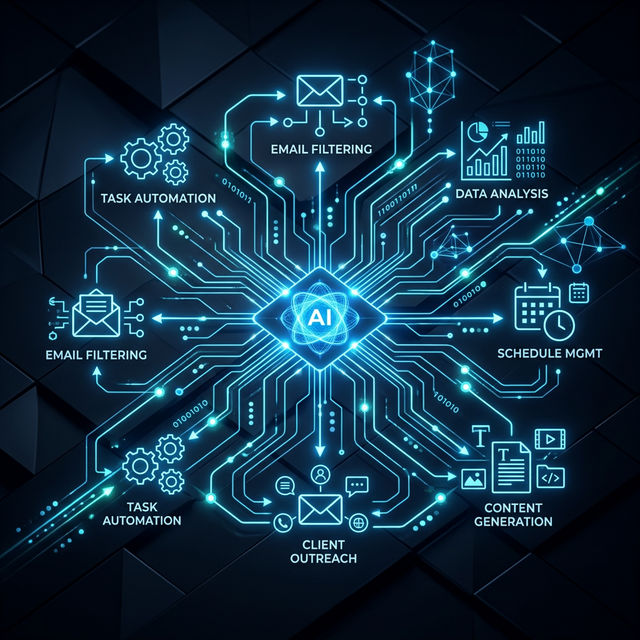
The contemporary digital environment requires more than just manual diligence; it demands architectural oversight. Automating your daily workflow isn't merely about writing scripts—it's about deploying a systematic methodology that treats your daily tasks as modular components within a broader computational network. Integrating AI into this pipeline drastically reduces latency between ideation and deployment.
1. The Core Principle of Algorithmic Delegation
Before implementing specific AI tools, an engineer must first normalize their data. Unstructured tasks are computationally expensive. By defining clear parameters—inputs, transforms, and desired outputs—you can begin routing specific functions to specialized algorithmic agents. This is the foundation of Algorithmic Delegation.
For instance, standardizing internal documentation formats ensures that Large Language Models (LLMs) can parse, cross-reference, and summarize technical logs without experiencing context window degradation.
2. Scripting High-Yield Routine Tasks
Automation yields the highest ROI on repetitive configurations. A robust digital professional should leverage local scripting environments (Python or Node.js) paired with an LLM core (like a local instance of LLaMA or an external API) to parse incoming data. Consider automated video parsing using FFmpeg: an AI can generate the command-line arguments needed to normalize, compress, and re-containerize media assets, pushing them directly to a remote storage server.
- Ingestion: Setting up a cron job to scrape necessary data endpoints.
- Processing: Parsing the raw data through an NLP model to extract actionable arrays.
- Execution: Invoking Bash or Python execution environments via standard out.
3. Integrating Asbab Gandul Logic into String Operations
When dealing with dynamic string outputs, particularly those merging left-to-right (LTR) and right-to-left (RTL) architectures, advanced string matching algorithms are required. Implementing the Asbab Gandul logic allows deep syntax resolution. Instead of mere whitespace concatenation, the system logically groups strings based on their unicode block matrices. This is vital when AI generates multilingual outputs that must be rendered correctly in static HTML DOM environments.
4. API Bridging for Continuous Integration
A true NEO-SYSTEMS approach connects disparite software silos. Using webhook nodes to pipe data between a local IDE, a project management dashboard, and a remote Ubuntu VPS enables continuous, silent deployment. Writing a centralized middleware layer allows the LLM to route status signals: e.g., "Build failed on Thread 4, deploying reversion commit."
5. Actionable Implementation Steps
To begin re-engineering your own workflow today, execute the following parameters sequentially:
- Audit your daily processes: Identify 3 tasks that do not require human creative variance.
- Deploy a local scripting environment and authenticate a programmatic AI API (e.g. OpenAI or a self-hosted local model).
- Write a baseline Python daemon to monitor a specific local directory (the "Ingest" folder).
- Configure the Python script to trigger an AI payload request specific to the filetype detected within the directory.
- Log all processes to a `.txt` file for subsequent algorithmic auditing and failure analysis.
// SYSTEM SUMMARY
Workflow automation via AI is not magic; it is simply precision engineering applied to standard operational procedures. By parsing your workload into discrete logical components, implementing local scripting environments, and utilizing APIs to interconnect software architectures, you establish strict digital sovereignty. This optimizes uptime, frees cognitive RAM, and drastically speeds up deployment pipelines for any digital professional.