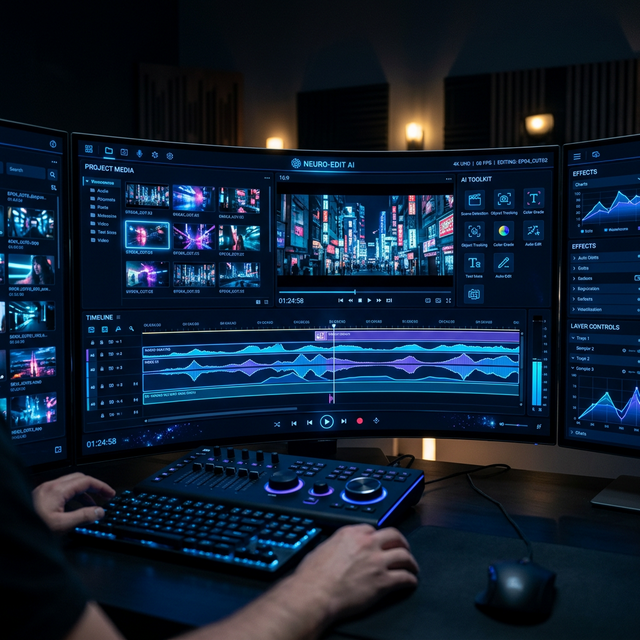
While Large Language Models (LLMs) like ChatGPT have revolutionized text-based output, the frontier of high-latency rendering and video editorial work requires entirely different neural network architectures. Video editing has historically been constrained by real-time hardware limitations—scrubbing a 4K timeline inherently taxes CPU/GPU infrastructure. Generative AI allows media engineers to decouple creative intent from hardware processing latency.
1. Rotoscoping and Masking via Machine Learning
Traditional rotoscoping is a frame-by-frame nightmare of Bezier curve manipulation. Modern AI algorithms, utilizing trained computer vision models, can now intelligently isolate subjects from their background across complex dynamic scenes without a greenscreen.
Tools implementing the Segment Anything Model (SAM) or proprietary Adobe Sensei networks drop masking workflows from hours to computationally insignificant seconds. For backend video processing, engineers deploy Python instances that access automated masking APIs to remove backgrounds programmatically before passing the raw stream back into software architectures like FFmpeg for final encode.
2. Generative In-filling and B-Roll Synthesis
Instead of relying on costly stock footage licensing algorithms parsing keyword metadata, editors can now dynamically inject synthetically generated B-Roll. Using diffusion models trained on video datasets, one simple text prompt can synthesize a 4-second establishing shot. This is highly effective when building scalable content funnels where high volume output is strictly required and creative context can be delegated to localized AI render nodes.
3. Audio Normalization and Voice Cloning
Clean audiovisual data requires pristine wave structures. AI excels at analyzing noisy audio tracks and applying inverse noise profiles to cleanly isolate human spectrum frequencies. In addition, deep-learning models can map the spectral nuances of a voice actor. When script revisions occur post-production, a text terminal interface can synthesize matching audio overdubs indistinguishable from the original studio recording.
4. Scripting FFmpeg AI Integrations
Real computational power is unlocked when pairing these visual AI models with command-line tools like FFmpeg. An editor executing in a Linux environment can write a bash script that pushes raw footage to an audio-transcription API, uses an LLM to identify the grammatical pauses in the timestamp array, and then commands FFmpeg to slice the silent frames out of the container—perfectly automating a "jump cut" edit for social media.
5. Implementing an AI Video Pipeline
Upgrade your current video processing loop via the following systematic steps:
- Move your heaviest rendering workloads offline by scripting remote FFmpeg servers to handle final encodes instead of your local workstation.
- Integrate an AI-based audio enhancer API to normalize speech waveforms rather than tweaking parametric EQs manually.
- Utilize automated transcription logic to generate accurate subtitle VTT/SRT files instantaneously.
- Test text-to-video diffusion generation models for specific B-roll requirements to eliminate stock-footage dependencies.
// SYSTEM SUMMARY
AI for video editing transcends novel generative art; it is a profound upgrade to media engineering syntax. By replacing manual rotoscoping, audio engineering, and rough-cut slicing with neural network algorithms and programmatic FFmpeg scripts, a single digital architect can output the volume of an entire 2020-era video production team.